
Claude Opus 5.5: API Costs for Coding and Visual Tasks
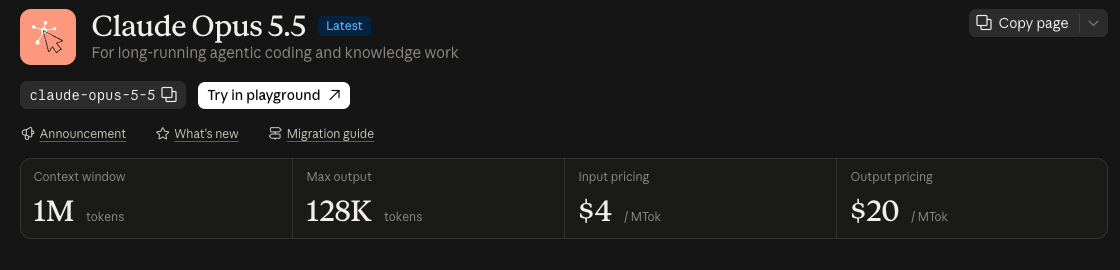
Claude Opus 5.5 is being used for long-running coding agents and, more visibly this week, code-drawn animations and product videos. It accepts text and images and returns text; a browser or rendering tool turns the code into moving images. Its Claude API rates are $4 per million input tokens and $20 per million output tokens, twice Sonnet 5.5’s. The choice depends on the accepted result, the revisions needed, and the total task cost.
Content reviewed:
Open the Claude Opus 5.5 model guide ↗Compare a different self-hosted text model
This page describes a hosted model. For a self-hosting budget, review these separate open-weight models and check their quality, tools and context limits against your task. Their estimates do not price this hosted model or establish equal capabilities.
Budget Qwen3.8-Flash-Next on your own hardwareUse this model
API docs and console
- Claude Messages API quickstart
Provider account and usage billing apply.
- Opus 5.5 platform-specific feature support
Provider account and usage billing apply.
Where does Claude Opus 5.5 make sense?
- Ambiguous repository changes: ask the agent to inspect a large codebase, identify competing designs, implement one path, and explain which tests support the result.
- Long-running audits and migrations: give the agent a bounded goal, access to the relevant tools, and checkpoints for actions that are expensive to reverse.
- Judgment-heavy document work: supply conflicting source material and evaluate whether the final decision cites the right evidence and handles exceptions.
- Code-drawn video and motion graphics: provide a storyboard, brand assets, and a visual acceptance check; have the agent build and render scenes, then inspect the finished cut.
Compare Opus with Haiku for routine steps
Haiku 5.5 offers lower starting token rates for routine extraction and routing, while Opus is a candidate for harder coding and knowledge work. Compare the full bill for accepted results, including cache, effort and retries; the Haiku guide separates short-prompt price ratios from long-context costs and same-High evaluation evidence.
When does security work need verified access?
Mythos 5.1 is another CVP model with a different cost profile: its Claude API input and output rates are $10 and $50 per million tokens. The Mythos guide separates program access, workspace setup and total request cost; choose it when the task benefits from that model within your approved scope.
Anthropic’s October 6 Cyber Verification Program covers advanced defensive security and authorized penetration testing with Opus 5.5. Routine code review, patching known issues and vulnerability discovery in code you own remain available through general access.
For advanced work, choose the relevant verification tier; Red Team Access is for organizations. For Claude Console/API access, the organization owner assigns the approved program to workspaces; Enterprise uses custom roles. Enrollment requires data retention, with a temporary exception for organizations already using Claude Fable 5.1 or Mythos 5.1 with Zero Data Retention. Verification is an access condition, not a new model or token-price discount.
Why some Codex users are adding Claude Opus 5.5 back
Every’s September 22 first-person review shows several different choices. Designer Tyler Nishida, who had left Claude, wanted Opus back for visual work but faced the cost of another $200 subscription. Dan Shipper still described his usage as 80/20 Codex versus Claude. Kieran Klaassen moved daily coding from Fable to Opus while keeping Astra for technical writing.
The named accounts describe different jobs moving to different tools. Identify the job you would move and the client features you would give up. Visual steering, model behavior, subscription limits and the coding client all affect that choice.
How to use Claude Opus 5.5
Select claude-opus-5-5 in the Claude API or a client that offers this exact model. The Claude Platform also lists Amazon Bedrock, Google Cloud, Microsoft Foundry, and Claude Platform on AWS. A coding client supplies repository access and runs tools; choosing the model alone does not give an API request permission to edit files.
For a first API trial, send one concrete task to the Messages API with model claude-opus-5-5, a max_tokens limit, and your input in messages. Keep the API key on the server. If you are migrating from Opus 5, read the model guide first: thinking cannot be disabled, forced tool use can return an error, and older computer-use tool versions are not accepted on some platforms.
curl https://api.anthropic.com/v1/messages \
  -H "x-api-key: $ANTHROPIC_API_KEY" \
  -H "anthropic-version: 2023-06-01" \
  -H "content-type: application/json" \
-d '{"model":"claude-opus-5-5","max_tokens":1200,"messages":[{"role":"user","content":"Review a SQLite schema migration plan. List the checks needed before deployment and the steps needed to roll it back."}]}'Why are people making videos with Claude Opus 5.5?
Motion design is a useful coding task for Claude Opus 5.5: animated typography, product UI transitions and short explainers can be drawn with HTML, SVG, Canvas or React. A renderer captures the frames and ffmpeg encodes the movie. Give the model a storyboard, readable text, a reference style and timing constraints before judging the finished cut.
Claude Video groups creator-attributed clips by format and links to the original posts. Some entries include the shared prompt, so you can inspect the cut and see how the creator described its scenes and timing.
“Made with Opus” does not mean native video generation. In one first-person account, Claude Code wrote HTML and GSAP compositions, rendered them in headless Chrome, and returned a 40-second promo. The creator watched each render and directed nine versions by voice. Locking the palette, typography, and motion rules helped prevent style drift; a frame-rendering bug still needed a code fix. That is a test of visual choices, timing, tooling, and revision discipline.
Another creator reported a 30-second SaaS launch video based on assets from an iOS simulator. Their transcript-based estimate was $7.74 and 22 minutes 49 seconds of API run time, with substantial cache use. It is one reported run, not a going rate for a finished video. For your own brief, count the renders and human revisions needed to approve the cut alongside tokens and elapsed time.
Raphaël Aubry’s MIT-licensed claude-motion-design skill supplies an HTML, Playwright and ffmpeg workflow. A seek(t) function draws any requested moment; a beat map coordinates motion and sound. Its process reviews four still frames before a full render, and the published Howseen launch example took five iterations. Budget for model calls, browser rendering and review time; music, fonts and other media keep their own license terms.
Vincentwei1021’s mg-styles-15 publishes fifteen ten-second films with prompts and source, covering typography, shape morphs and other styles. The author reports two review and revision rounds per film. Use the gallery to choose a visual reference and inspect its code, then test legibility on a phone before rendering at full resolution.
On Hacker News, minimaxir points to editable source as a useful distinction in these clips, while gAI describes asking Opus for an After Effects JSX script to continue editing in their usual tool. Choose a workflow that leaves you able to change the scene and timing after the first render.
The author’s September 25 post shows a twenty-second product demo drawn in code. Watch the original X post here or open it on X.
This demo stays off with necessary cookies only. Enable optional technologies in Cookie Settings, then choose whether to load it.
Loading this demo contacts X, which may use cookies and receive your IP address. Nothing loads until you enable optional technologies and click Load X demo.
- Explore the Claude Video creator index ↗
- Explore Remotion for code-rendered video ↗
- Howseen motion-design skill and worked example ↗
- Fifteen motion styles: prompts and source ↗
- Watch the fifteen-style gallery ↗
- Hacker News: editable code and an After Effects handoff ↗
- verbove’s MakerMap motion demo on X (opens X) ↗
- Read the nine-version Opus promo workflow ↗
- Read the SaaS launch video cost report ↗
Opus for planning and review, Sol for implementation
On October 1, Anton Odelski described a Godot tactical-RPG workflow on X. Opus 5.5 at max handled planning, specifications and review; an xhigh chat handled UI and 3D design; Sonnet checked visible results; Sol wrote code in Codex. Executors used separate Git worktrees. The author reported fourteen tasks closed over two days, about 15% of the weekly Codex quota used and 97% cached Sol input.
That division is a practical way to evaluate the premium model’s contribution: ask Opus to resolve design uncertainty or review the implementation, then price the whole accepted change. The post reports no absolute dollar bill or token totals. Its quota percentage describes that account’s subscription usage, and cannot be converted into API savings.
In a separate first-person refactor test at medium effort, the author reported equivalent results after one follow-up for each model: Sol used 18% of a five-hour subscription limit, Opus 7%. That is a subscription-capacity observation rather than an API price comparison.
Keep a planning-and-review run separate from a test in which both models implement the entire task. Record human design approval, rejected patches and repair work too. A workflow that splits roles can be useful even when it provides no direct ranking of the two models.
Claude Opus 5.5 API pricing and task cost
As checked September 30, 2026, standard Claude API pricing is $4 per 1M uncached input tokens, $20 per 1M output tokens, $0.20 per 1M cache reads, and $5 per 1M five-minute cache writes. One-hour cache writes cost $8 per 1M. Fast mode is a separate choice at $8 input and $40 output per 1M. These are API rates, not Claude subscription charges.
Suppose an architecture task uses 250,000 uncached input tokens and 30,000 output tokens across its run. At standard rates that is $1.00 of input plus $0.60 of output, or $1.60. Cache hits, cache writes, tool calls, repeated attempts, and a different output count change the bill.
Opus costs twice Sonnet per uncached input and output token, but a completed task need not cost twice as much. Record total spend and successful outcomes across the same issue. If Opus avoids a failed attempt or substantial rework, its higher unit price may be justified; if both produce an acceptable patch, Sonnet’s lower rates matter more.
When is Opus 5.5 Fast mode worth the premium?
Anthropic advertises up to 2.5× higher output tokens per second with the same model weights and capabilities. The gain targets output generation, not time to first token. Tool execution, network waits and review still contribute to elapsed task time.
Fast mode is offered in Claude Code and as a research preview on the Claude API, including Managed Agents. API access requires approval; opt in with speed: "fast" and the fast-mode-2026-02-01 beta header. It is unavailable on Bedrock, Claude Platform on AWS, Google Cloud, Microsoft Foundry, Batch and Priority Tier commitments.
Consider the premium for interactive work where waiting for streamed output blocks your next decision. At the existing example’s unchanged token counts, Fast costs $3.20 versus $1.60. Compare accepted-task time and spend at the same effort and tool settings. Standard is the better budget choice for unattended work or runs dominated by tools. Switching speeds also loses prompt-cache reuse between them.
What the coding evidence says about Claude Opus 5.5
For coding, the harder question is whether Claude Opus 5.5 keeps a long task on course when the first plan is wrong. Anthropic’s migration and audit examples suggest tasks to try, but their tools, repositories, and review criteria differ from yours. Test one issue where choosing the wrong approach would create substantial rework.
An independent Artificial Analysis review found Opus 5.5 strong on its evaluation suite while noting substantial output-token use at max effort. That is why a higher score alone cannot decide the API budget. Check whether the same effort setting and agent harness are used before comparing benchmark figures across vendors.
Test whether the Claude Opus 5.5 premium pays
For a repository issue, freeze the revision, prompt, tools, success checks, and time limit. Run Opus and an alternative three times each, then review the patch and tests. For a video brief, fix the storyboard, assets, length, and render settings; have a reviewer mark visual defects and approve or reject each cut.
Record accepted results, elapsed minutes, API spend, cache use, output tokens, tool calls, and revision rounds. Divide total spend by accepted results. A visually striking first render can still be expensive if timing, legibility, or brand details require repeated repair.
How does Claude Opus 5.5 compare?
Opus is the higher-priced Claude choice for difficult work. Sonnet 5.5 tests whether a less expensive Claude can reach the same result on scoped tasks. GPT-6.1 Sol tests how a lower-priced reasoning API behaves when the work is hard enough to justify more effort.
When is Sonnet already enough?
For a routine bug fix or a motion brief with a defined storyboard, test Sonnet 5.5 first. Its $2 input and $10 output rates per million tokens are half Opus’s standard rates. Compare the accepted patch or cut, including the revisions required to get there.
Move to Opus when the task requires choosing among several plausible designs, maintaining direction over a long session, or checking a costly decision against conflicting evidence. Measure successful-task cost rather than assuming the more expensive model always needs more tokens.
How should difficult agent work be compared?
GPT-6.1 Sol lists $2 input and $10 output per million tokens, but its reasoning effort can change the number of output tokens, the path through tools, and the time to finish. Opus uses adaptive thinking with a medium default on the Claude API. Matching a label such as “high” across providers does not produce a matched test.
Give both agents the same difficult issue and the same approval rules. Compare accepted patches, time, and total billed usage. Include cache charges and retries. If Sol needs more turns, the lower token rate may not translate into a lower completed-task cost.
Before you use it
- Opus 5.5 is a hosted, closed-weight model. A local hardware estimate for open weights does not describe its inference cost.
- The 1M-token context window is a capacity limit. Putting more files in one prompt still raises input cost and can make the task harder to review.
- API model behavior, prices, and available service tiers can change; the linked model guide is the source for a new purchasing decision.
How to get started
Start Claude Opus 5.5 with a difficult repository issue or a video brief that needs repeated direction. Compare Sonnet on the same issue or storyboard, then record the accepted result, revision rounds, total API spend, and elapsed time.
Sources
Sources (18)
- Anthropic Opus availability and Fast mode ↗
Source checked:
- Opus 5.5 feature changes ↗
Source checked:
- Anthropic Fast mode documentation ↗
Source checked:
- Anthropic Cyber Verification Program access requirements ↗
Source checked:
- Hacker News discussion of code rendering and editing ↗
Source checked:
- Howseen motion-design workflow and example ↗
Source checked:
- Fifteen motion styles and revision workflow ↗
Source checked:
- Every’s first-person Opus 5.5 task and default-tool review ↗
Source checked:
- Anton Odelski’s Godot agent workflow ↗
Source checked:
- Forti22 subscription refactor comparison ↗
Source checked:
- Claude Opus 5.5 model specifications and pricing ↗
Source checked:
- Anthropic Opus 5.5 release report ↗
Source checked:
- Artificial Analysis Opus 5.5 evaluation ↗
Source checked:
- Creator-attributed Claude 5.5 video archive ↗
Source checked:
- Claude Video independent creator index ↗
Source checked:
- Remotion code-based video renderer ↗
Source checked:
- Opus 5.5 nine-version promo creator report ↗
Source checked:
- Opus 5.5 SaaS video cost creator report ↗
Source checked: