
Microsoft-Decision-1: Classification, Routing and API Cost
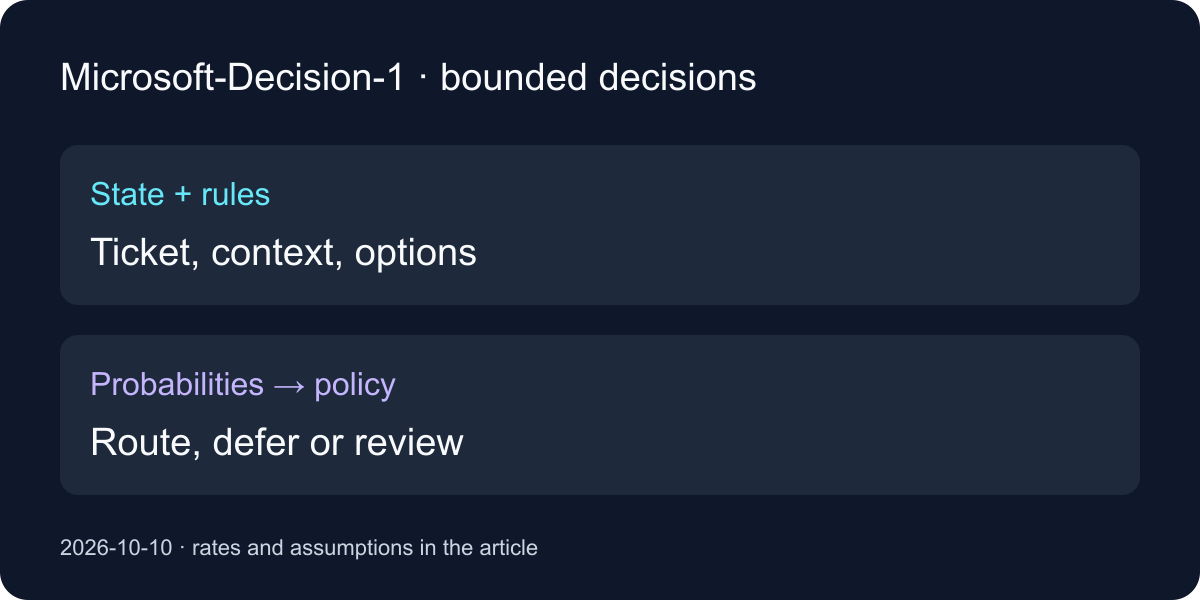
Microsoft-Decision-1 scores a fixed set of answers for classification, routing and workflow control. Microsoft post-trained Qwen3.5-9B for single-pass decision scoring. It is available in Microsoft Foundry and listed on OpenRouter through Azure at $0.042 per million input tokens, with free output. Define the allowed actions, then use probabilities to decide whether to act or request review.
Content reviewed:
Use this model
API docs and console
- Open Microsoft-Decision-1 in Foundry
Provider account and usage billing apply.
Use cases
- Route a support ticket to a predefined team or escalation queue.
- Grade a proposed agent action against explicit criteria before proceeding.
- Classify feedback into a fixed taxonomy or prioritize an incident.
How the model turns options into decisions
Microsoft-Decision-1 reads supplied content and returns a probability for each permitted answer. The API supports yes/no, multiple-choice and rating questions, including rubric-based grading. A single pass scores the options instead of generating a prose answer. The listed context limit is 32,768 tokens; input is text only and output is structured probabilities. It does not accept images or provide a conversational response.
The application supplies the state, the question and the allowed options. For ticket routing, include the relevant ticket and define billing, technical, sales and an escalation option. The response helps choose a route; your application determines the confidence threshold and what happens when evidence is insufficient.
Use a generative model when you need an explanation, translation, summary or code. A decision model fits the bounded choice that comes before or after that work. Keep classification labels and their definitions stable so measured changes reflect the model rather than a changing taxonomy.
Use the official Foundry request format
Open the Foundry catalog entry, deploy Microsoft-Decision-1 to an available endpoint and copy that deployment’s endpoint and name. The official example posts to the systemone route shown in the request below, using your Azure endpoint and a Microsoft Entra bearer token. The model field is your deployment name.
The body contains state and questions. A choice question includes instructions and criteria mapping each option to its meaning. Begin with a small labeled example and inspect the returned probabilities before connecting the response to a real action. The example below shows the official request shape adapted to ticket routing; it has not been executed here.
Foundry’s launch article describes public preview. Use the lifecycle and regional deployment options displayed in your Foundry account when provisioning; the working access route is Foundry. OpenRouter currently lists Azure as a provider.
curl "$AZURE_ENDPOINT/providers/microsoft/v1/systemone" \
  -H "Authorization: Bearer $ENTRA_ACCESS_TOKEN" \
  -H "Content-Type: application/json" \
  -d '{
    "model": "YOUR_DEPLOYMENT_NAME",
    "state": "Checkout fails for every customer after the release.",
    "questions": {
      "team": {
        "type": "choice",
        "instructions": "Choose the team that should investigate.",
        "criteria": {
          "billing": "Payment amounts, invoices or refunds",
          "technical": "Errors, outages or software failures",
          "review": "Insufficient evidence to assign a team"
        }
      }
    }
}'Microsoft-Decision-1 input-token pricing
Microsoft and OpenRouter list $0.042 per million input tokens and no output-token charge, checked October 10, 2026. Count the full input: state, rules, option descriptions and other request context. Repeating a check consumes another request’s input.
For 1,000 judgments using 1,000 total input tokens each, the input volume is one million tokens and the model cost is $0.042. One million such judgments cost $42. If each judgment instead uses 5,000 input tokens, one million judgments cost $210.
These examples use the listed token rate and exclude other application services. When routing through OpenRouter, inspect the selected provider and current rate so the measured bill matches the Azure listing. OpenRouter documents a dedicated /api/alpha/decisions interface; its published example uses Jev, so follow the provider-specific contract when adapting an integration.
| Judgments | Input tokens per judgment | Total input | USD model cost |
|---|---|---|---|
| 1,000 | 1,000 | 1M | $0.042 |
| 1,000,000 | 1,000 | 1B | $42 |
| 1,000,000 | 5,000 | 5B | $210 |
What Microsoft’s benchmarks establish
Microsoft reports the highest accuracy in its comparison of 36 benchmarks covering nearly 150,000 questions kept blind from training. It also reports faster execution than the compared models. Those are publisher measurements for its structured-decision evaluation, rather than a same-cost ranking for every application.
The launch article reports a 1.3% average decision-flip rate under eight input perturbations. The tests include paraphrasing and changing choice order. That robustness result is useful when planning a test set, but confidence still needs calibration on the labels and cases your application uses.
OpenRouter’s live provider metrics describe public service behavior and change over time. They are separate from Microsoft’s benchmark timing. Before selecting a hot-path classifier, measure network latency, concurrency, ambiguous inputs and out-of-distribution cases from the runtime that will call it.
Compare decision models on your own labeled cases
Clef and Clef-flash provide Workers AI endpoints and downloadable weights. Clef-omni adds audio and video evidence. Choose them for a Cloudflare workflow or when the supported input and deployment options fit; compare the full input bill and calibrated thresholds with Microsoft-Decision-1.
Perplexity Decider and the OpenAI Decisions route offer other hosted choices. Preserve the same state and allowed options when comparing, but adapt each service’s wire format and interpretation of scores. A lower token price helps only if errors and repeated checks do not consume the savings.
Before you use it
- Fixed-option scoring requires a defined set of answers and an application policy for ambiguous cases.
- Foundry deployment names and endpoint authentication differ from ordinary chat-completion requests.
How to get started
Create a Foundry deployment, submit a state and typed questions, and calibrate action thresholds using labeled examples before automating a workflow.
Sources
Sources (5)
- Microsoft: model and benchmark announcement ↗
Source checked:
- Microsoft: Foundry deployment example ↗
Source checked:
- Microsoft Foundry: model catalog ↗
Source checked:
- OpenRouter: current price and Azure provider ↗
Source checked:
- OpenRouter: alpha decisions interface ↗
Source checked: