
Gemini 4 Argon: Access, API Pricing and Long Tasks
Gemini 4 Argon is Google’s model for long software-engineering, enterprise and research tasks. Since October 13, developers can use its paid API and subscribers can access it through supported Google products. Introductory API input/output rates are $2/$10 per million tokens through November 30, then $4/$20 from December 1. Independent evaluations show strong task results alongside substantial output-token use, which makes the full task bill worth comparing.
Content reviewed:
See Gemini 4 Argon access and pricing ↗Use this model
API docs and console
- Gemini API model list
Provider account and usage billing apply.
- Google’s robotics examples and paid API entry point
Provider account and usage billing apply.
- Interactions API guide
Provider account and usage billing apply.
Which tasks is Gemini 4 Argon designed for?
- Long repository migrations where an agent inspects code, implements changes and verifies behavior across many files.
- Enterprise research and analysis that combine documents, tools and several rounds of evidence checking.
- Defensive security investigation for organizations admitted to Google’s Fairwind Program.
- Extended reasoning and tool use where a short answer budget would interrupt the task.
Who can actually use Gemini 4 Argon?
Defensive-security teams can apply through Fairwind. Describe your organization and defensive use case in the application; Google reviews eligibility and grants access to selected partners. An application is the first step, not immediate model access.
Wiz’s September 30 update says Scan for Good uses Argon alongside Gemini 3.8 Flash Cyber.
On October 1, Google employee Jaana Dogan described extensive internal use of Argon for development, security scans and complex network troubleshooting, with positive feedback. Her post is a first-person account of employee workflows and internal access.
On October 13, Google opened Argon to developers through the paid Gemini API in AI Studio and Gemini platform. Google AI Ultra includes access in Antigravity; Pro and Ultra include it in the Gemini app and AI Mode. Subscription allowances and API token charges are separate.
Fairwind remains the route for the expanded defensive-security partner program. Its cyber access is separate from the public model rollout.
Gemini 4 Argon API access and subscriptions
Approved teams should use the access instructions supplied by Google for their organization. Google also makes Argon available in CodeMender to selected Fairwind partners for vulnerability research and patching.
For a public API request, enable billing on a supported Gemini API project, create its API key in AI Studio and select gemini-4-argon. The model accepts text, images, video, audio and PDFs, and produces text. The Developer API lists paid access, with no free tier for Argon.
Start with a bounded repository task or document question and inspect the returned token usage. Use the official model guide for supported tools and long decode; compare the same tools and acceptance tests with Sol or Claude.
Budget a multi-turn robotics task with Argon
Google’s October 13 robotics examples use the general gemini-4-argon model through the paid Gemini API and Interactions API. This is another application of Argon, not a separately priced robotics checkpoint. The demos combine visual observations, code, simulator feedback and action primitives; your application supplies the robot integration and execution controls.
Assume each reasoning turn bills 5,000 uncached input tokens and 1,000 output tokens including thinking. At the introductory $2/$10 rates, one turn costs $0.02: $0.01 input plus $0.01 output. Twenty such turns cost $0.40 and 100 cost $2. At the announced $4/$20 rates from December 1, those totals double. The introduction runs through November 30; the price section below contains the full rates.
A real loop can grow as observations and history accumulate. Sum returned usage for every call, including recovery attempts, rather than multiplying a short final answer by a token rate. Track simulator or world-model generation, robot hardware, camera capture, compute and integration separately. The example above prices only assumed Argon tokens; it does not estimate the cost of operating a robot.
Gemini 4 Argon’s 1M output-token trajectory
The public model has a unified 1,048,576-token input-and-output context. Default synchronous output is capped at 65,536 tokens; long decode can extend output within the shared context. Reserve room for both the input and generated trajectory. Thinking tokens count toward output billing even when the final answer is short.
Artificial Analysis tested Long Decode Continuation, which pauses a long response and resumes it across follow-up calls to avoid request timeouts. Vals’ published evaluation instead caps output at 262,144 tokens, with high reasoning and temperature 1. Those are different evaluation settings; use the actual output budget in your task comparison.
A longer budget is useful when the work needs it. For a small patch or a short answer, set an acceptance test and stop after the task is complete. Record the full billed trajectory, including reasoning, rather than measuring only the final message.
Gemini 4 Argon pricing and a task-cost example
The Gemini Developer API’s introductory rates in USD are $2 per million input tokens and $10 per million output tokens through November 30, 2026. From December 1, they become $4 and $20. Implicit cached input costs $0.10, then $0.20; explicit caching is unsupported.
A task totaling one million uncached input tokens and 100,000 output tokens across several calls costs $3 at introductory rates and $6 at standard rates. If 900,000 of those input tokens qualify for cache pricing, the totals are $1.29 and $2.58. These token-only estimates use cached-input rates derived as 5% of the announced input rates. Tool charges are excluded. Google Search grounding shares 5,000 free monthly search queries across Gemini 3 and newer models, then costs $14 per 1,000 queries; a request can issue several queries.
For 1,000 tasks using 10,000 uncached input tokens and 2,000 output tokens each, the total is $40 at introductory rates and $80 afterward. At the announced output rate, a full one-million-token output trajectory alone costs $10 during the introduction and $20 afterward. An input-token discount can be outweighed by long output or repeated attempts. Count costs per accepted result when comparing an agent workflow.
| Per 1M tokens | Introductory through November 30 | From December 1 |
|---|---|---|
| Uncached input | $2.00 | $4.00 |
| Implicit cached input | $0.10 | $0.20 |
| Output | $10.00 | $20.00 |
| Task total across calls: 1M input + 100K output | $3.00 | $6.00 |
Independent Gemini 4 Argon evaluations
Artificial Analysis gives Argon (high) an Intelligence Index score of 53, matching GPT-6 Astra (max). At introductory pricing it reports $1.99 per task, rising to $3.98 at standard rates, versus GPT-6 Astra (max) at $3.26. Argon averages about 62,000 output tokens per task in this evaluation, compared with about 27,000 for Astra. Its cost advantage over Astra at launch comes from price, while it consumes more output.
Vals Index v2.1 (checked October 6, 2026) reports 68.90% at $15.68 per test, using the later $4/$20 rates. Its GDP-weighted mix of finance, coding, legal and tax tasks is a broader knowledge-work measure than a coding benchmark.
These are evaluations run by the named testing organizations. A developer’s task can use different tools, stopping rules and output limits. Keep that configuration with the result, and include failed attempts in the cost when the workflow needs retries.

Gemini 4 Argon in Google’s engineering work
Google reports ongoing C/C++ to Rust migrations, including the 800K-plus-line Fuchsia Zircon kernel. For libgav1, agents replaced 32K lines of SIMD code in an existing Rust port; Google reports identical video output and a 2.7× speedup against that Rust port. The kernel migration is work under review, rather than a completed production rewrite.
For a repository migration, define a testable subset before a full conversion: one library, its tests and a performance baseline. Evaluate behavior, patch review time and the cost of reaching an accepted version.
Financial research: accuracy, time and cost
For multi-step research on company filings, Vals Finance Agent v2 (checked October 6, 2026) gives Argon 65.40%, versus Gemini 3.8 Flash at 61.44%. Argon costs $4.38 per test and takes 16m21s; Flash costs $2.00 and takes 3m21s. The Argon bill uses $4/$20 token rates, not the launch discount.
That is a 3.96-point accuracy gain with more than twice the cost and roughly five times the duration in this evaluation. Argon is a candidate for difficult filing questions when the extra accuracy matters; Flash is the faster comparison for routine retrieval. The percentage includes partial credit, so it is not the share of fully correct financial reports.
| Finance Agent v2 | Accuracy | Cost per test | Duration |
|---|---|---|---|
| Gemini 4 Argon | 65.40% | $4.38 ($4/$20 rates) | 16m21s |
| Gemini 3.8 Flash | 61.44% | $2.00 | 3m21s |
Where the coding results change the choice
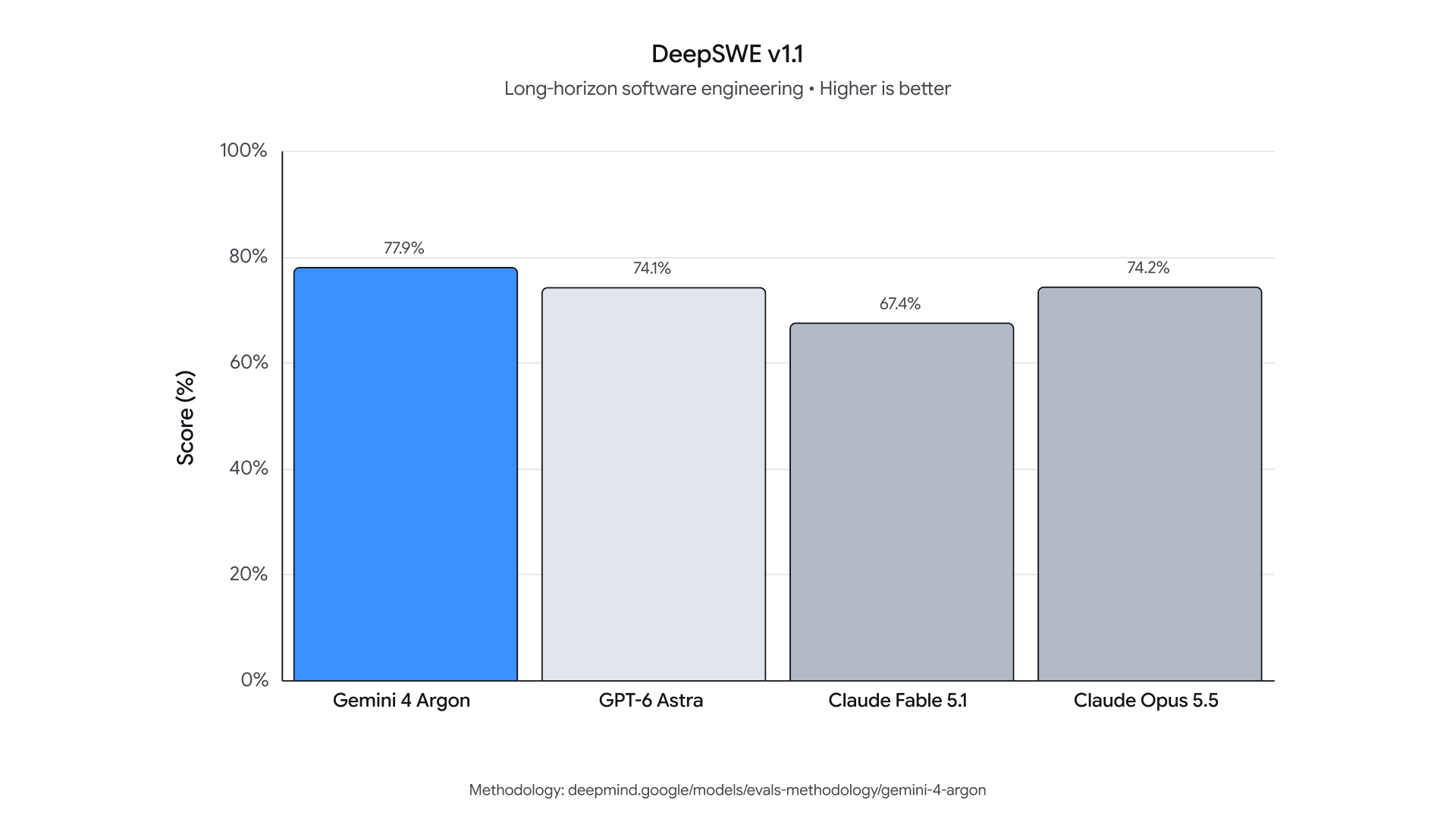
Google’s comparison shows Argon at 77.9% on DeepSWE v1.1, against Astra at 74.1% and Opus at 74.2%. FrontierSWE v2 instead places Argon at 55.0%, against Astra at 65.5% and Opus at 62.3%. Terminal-bench 4.0 gives Argon 57.4%, Astra 58.2% and Opus 66.4%. The methodology uses the highest thinking settings for most Argon tests and mixes Google-computed results with vendor and leaderboard reports. These are not same-cost, same-harness rankings; sustained repository changes and terminal tasks can produce different choices.
For your first eligible run, choose a bounded migration with a known test suite, provide the source and build instructions, and ask for a patch plus test evidence. Review the changed behavior and performance before expanding the task. Use Google’s DeepSWE chart as a starting point for long engineering tasks, then compare the accepted patch on your repository.
Gemini 4 Argon FAQ
Can I call Argon with my existing Gemini API key? Use gemini-4-argon on an eligible paid project. A Google AI subscription does not supply API token credit; enable API billing separately.
Does 1M mean the context window? The public model shares 1,048,576 tokens between input and output. The synchronous output cap is 65,536; longer output uses long decode and still fits inside that shared window.
Can I run Argon on my own GPU? Google’s announced access is hosted through its rollout. The release does not link an official downloadable checkpoint, so this page has no Argon hardware-cost configuration.
Is the Ultra subscription the same as the API token bill? They are separate access and billing routes. Google lists Pro and Ultra access in the Gemini app and AI Mode, and Ultra in Antigravity. Use the token examples here for API planning, not as an Ultra allowance.
Gemini 4 Argon vs GPT and Claude
Compare the result and the complete task bill on the same workload. Reasoning settings, output length and retry behavior can change the choice.
Does Gemini 4 Argon cost less than GPT-6.1 Sol?
Artificial Analysis reports Argon (high) at 53 on its Intelligence Index and GPT-6.1 Sol (max) at 52. At introductory prices, Argon costs $1.99 per index task, about 2.7 times Sol’s cost in that evaluation. A higher score by one point does not by itself justify switching a workflow.
Choose a representative repository task, keep the tools and acceptance tests fixed, and record billed tokens and revisions. Sol’s page includes task reports and reasoning choices that can help build that comparison.
Where does Gemini 4 Argon differ from Claude?
Vals reports a 68.90% aggregate index result for Argon, ahead of Sonnet 5.5 at 67.04% and Opus 5.5 at 66.97%. Google’s selected Terminal-bench 4.0 comparison instead places Argon at 57.4% and Opus 5.5 at 66.4%. These separate benchmarks answer different questions: stronger aggregate knowledge-work results do not make Argon the best choice for every coding task.
Argon’s standard $4/$20 token rates match Opus 5.5’s listed rates; its introduction halves them. Compare how much work each model completes, how long it runs and how many output tokens it bills. Use the Claude task guides for coding and visual work when defining the trial.
Before you use it
- Use a paid Gemini API project for public API access; Fairwind governs the separate defensive-security partner program.
- Long output trajectories can dominate token charges. Choose a budget and stopping condition for the task.
How to get started
Check the official access route. When you can run Argon, compare it with Sol or Claude on a fixed task, tools and acceptance test, keeping the complete token bill and revisions with the result.
Sources
Sources (15)
- Google robotics workflows and access ↗
Source checked:
- Google: October 13 public access and subscription channels ↗
Source checked:
- Google: public model ID and unified context limits ↗
Source checked:
- Google: Argon evaluation methodology ↗
Source checked:
- Google employee Jaana Dogan: first-person internal use ↗
Source checked:
- Gemini API public model list ↗
Source checked:
- Gemini API public pricing ↗
Source checked:
- Google’s Argon benchmark table ↗
Source checked:
- Vals Index v2.1 ↗
Source checked:
- Vals Finance Agent v2 ↗
Source checked:
- Fairwind eligibility and selected-partner access ↗
Source checked:
- Wiz’s September 30 Scan for Good update ↗
Source checked:
- Google: Gemini 4 Argon access, pricing and engineering tasks ↗
Source checked:
- Artificial Analysis: independent evaluation and task costs ↗
Source checked:
- Vals: independent benchmarks and evaluation settings ↗
Source checked: