
Seedream 5 Flash: Image Generation, Editing and API Cost
Seedream 5 Flash is ByteDance’s hosted image-generation and editing model for quick visual iterations. It supports 1K, 1.5K and 2K images, up to ten reference images and layered output. BytePlus lists $0.018 per output image; Volcengine lists ¥0.12. Choose the model ID and billing route for your account before estimating a batch.
Content reviewed:
Open the Seedream image-generation guide ↗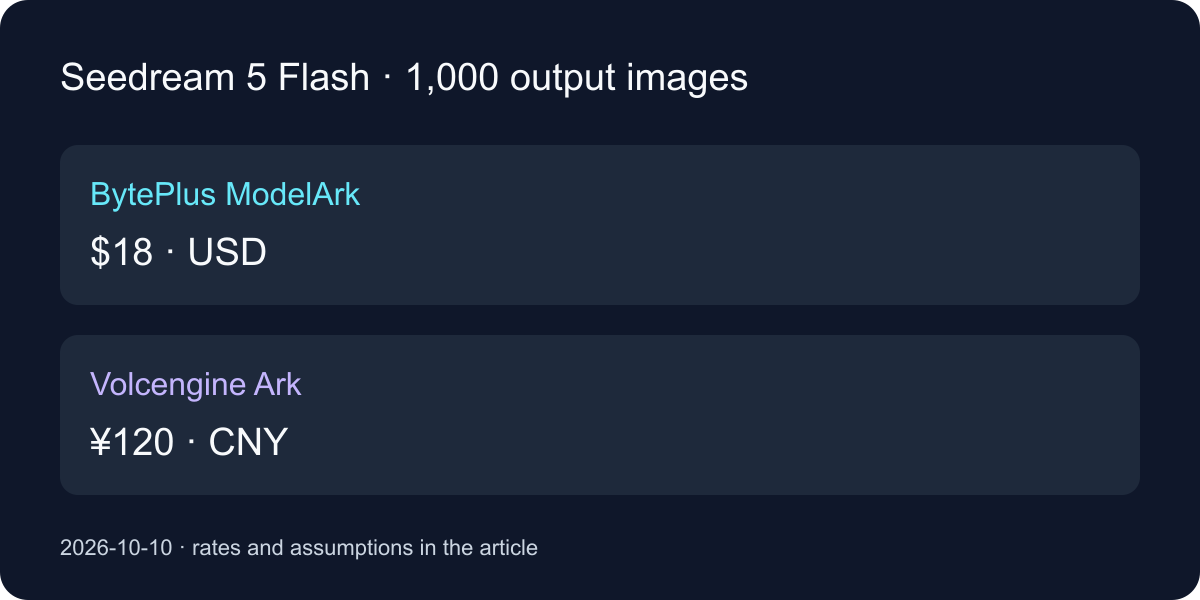
Use this model
API docs and console
- Volcengine image-generation request reference
Provider account and usage billing apply.
- BytePlus image-generation request reference
Provider account and usage billing apply.
Use cases
- Create product and campaign image variations from a prompt and reference images.
- Make targeted edits while preserving the supplied subject and composition.
- Produce a base image and separate layers for later design work.
What can Seedream 5 Flash generate and edit?
Flash combines text-to-image generation with image editing. Supply the brief alone for a new scene, or attach references and describe the intended changes. The documented limits are 1K, 1.5K and 2K output and up to ten reference images.
For a product edit, describe what must stay fixed as well as what changes: preserve the packaging and printed label, change the background to a plain studio setting, and keep the original camera angle. Inspect small text and product details before accepting the image.
Interactive precise editing and layer decomposition serve different workflows. Precise editing changes a selected part of an image. Layer decomposition requires one PNG or JPEG input image and returns a base image plus up to sixteen transparent layers for later design work.
Choose the correct regional model ID
On Volcengine Ark in mainland China, select doubao-seedream-5-0-flash-260915. On BytePlus ModelArk, select dola-seedream-5-0-flash-260915. The two names identify different service routes; use the ID shown for the account and endpoint you are calling.
First enable the model in your provider console and obtain an API key. Open that provider’s image-generation reference, use its endpoint and authentication headers, then send the exact model ID, prompt and requested size. For editing, include your reference images using the documented image input. Save returned image URLs or image data before continuing to the next operation.
Keep the key on your server. Start with one image and a fixed prompt, confirm the output size and charge in the console, then scale the batch. Use standard prompt optimization for Flash.
| Account route | Exact API model ID | Official entry |
|---|---|---|
| Volcengine Ark | doubao-seedream-5-0-flash-260915 | Ark image-generation API |
| BytePlus ModelArk | dola-seedream-5-0-flash-260915 | ModelArk image-generation API |
Seedream 5 Flash pricing per output image
As checked October 10, 2026, BytePlus lists free input and $0.018 per output image. Volcengine lists ¥0.12 per output image. These are the published prices for their respective services, not estimates produced by converting currencies.
At those rates, 1,000 output images cost $18 on BytePlus or ¥120 on Volcengine. Ten accepted images made from three attempts each require thirty billed output images: $0.54 or ¥3.60. Track the output count across retries when budgeting cost per accepted asset.
Layer decomposition is charged by output image, rather than treating every request as one image. A request returning one base image and sixteen separate layers produces seventeen images. At the listed rates, that is $0.306 on BytePlus or ¥2.04 on Volcengine. Storage and delivery costs in your application are separate from this image-generation arithmetic.
| Output count | BytePlus USD | Volcengine CNY |
|---|---|---|
| 1 | $0.018 | ¥0.12 |
| 17: base plus 16 layers | $0.306 | ¥2.04 |
| 1,000 | $18 | ¥120 |
Flash, Lite or an open-weight image model?
Choose Flash when your workflow needs the documented resolution range, reference-based edits or separate layers. ByteDance positions Flash as the faster option; a precise end-to-end latency depends on the service and request, so evaluate turnaround from your own calling region.
Flash does not support Lite’s group-image generation, web search or streaming output. Consult the official capability comparison linked above when any of those features is part of the brief. A sample labeled Seedream Pro is evidence for Pro, rather than a demonstration of Flash output.
Qwen Image 2.1 offers downloadable weights alongside hosted Turbo and Pro services. Compare it when transparency or your own inference environment matters. Seedream Flash’s route here is a hosted API; it has no self-hosted hardware configuration on this site.
Check the image you will actually ship
Use a small set of prompts that represents your production work: a product with a legible label, a composition with several references, and a local edit with a fixed subject. Keep the reference images, requested size and acceptance criteria constant when comparing services.
The useful record is accepted images, output count, total charge and elapsed time for the complete edit. Publisher examples show intended capabilities; they do not establish a success rate for your products or typography.
Before you use it
- Flash supports 1K, 1.5K and 2K output; select another model when you need a feature outside its documented capability table.
- Layered output and repeated edits can produce several billed images for one accepted asset.
How to get started
Enable Flash in your regional provider console, use the matching API ID, and test one prompt or edit before estimating a larger batch.
Sources
Sources (5)
- Volcengine: Seedream capabilities ↗
Source checked:
- Volcengine: image-generation API ↗
Source checked:
- BytePlus: image-generation API ↗
Source checked:
- BytePlus: model pricing ↗
Source checked:
- Volcengine: model pricing ↗
Source checked: