
Claude Sonnet 5.5: API Costs for Coding and Visual Tasks
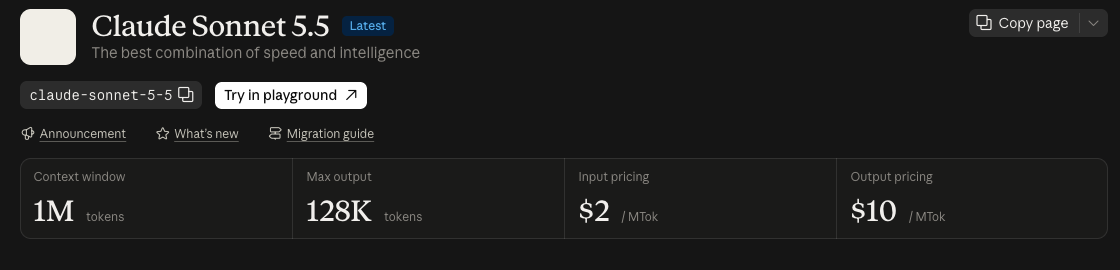
Claude Sonnet 5.5 is being used for routine coding, bug fixes, documents, and code-drawn animation. Its standard Claude API rates are $2 per million input tokens and $10 per million output tokens, half Opus 5.5’s uncached rates. Early creator reports show that a cheaper model can also build visual work, but the useful measure is the time, tool calls, and revisions needed for an accepted result.
Content reviewed:
Open the Claude Sonnet 5.5 model guide ↗Compare a different self-hosted text model
This page describes a hosted model. For a self-hosting budget, review these separate open-weight models and check their quality, tools and context limits against your task. Their estimates do not price this hosted model or establish equal capabilities.
Budget Qwen3.8-Flash-Next on your own hardwareUse this model
API docs and console
- Claude Messages API quickstart
Provider account and usage billing apply.
What is Claude Sonnet 5.5 good at?
- Well-defined coding tickets: give a repository issue with an acceptance test and ask the agent to find the files, make the change, run checks, and stop.
- High-volume agent work: compare completed-task cost and elapsed time when the same bounded task runs many times.
- Documents, slides, and spreadsheets: provide source material and a concrete output format, then review whether the artifact follows the requested structure and facts.
- Visual builds: ask for a small interactive scene or animation, render it, and inspect frames for clipping, timing, and missing elements.
Using Sonnet 5.5 for security work
Sonnet 5.5 is included in Anthropic’s October 6 Cyber Verification Program. Standard access still covers routine patching, code review and alert triage. Advanced defensive work and authorized penetration testing use verified tiers.
Check eligibility before planning a security workflow: Red Team Access is organization-only, Claude Console/API access must be assigned to workspaces by the organization owner, and data-retention requirements apply, with a temporary exception for organizations already using Claude Fable 5.1 or Mythos 5.1 with Zero Data Retention.
Claude Sonnet 5.5 in GitHub Copilot
GitHub made Sonnet 5.5 generally available in Copilot on September 28. Its early Copilot test found faster completion with fewer steps, tokens and tool calls on coding tasks. Use that integration result as the setup for your own comparison.
If you already use Copilot, select Sonnet 5.5 for a well-scoped issue and compare the complete accepted change with your current model. Measure review time and repair turns as well as generation time. The returning-to-Claude reports in this release window mostly concern Opus; use a scoped Sonnet task to decide whether it fits your default workflow.
Start Claude Sonnet 5.5 with a scoped task
Anthropic positions Claude Sonnet 5.5 as the practical complement to Opus 5.5 for everyday tasks and bug fixes. In a coding client, the surrounding application supplies file access, tool execution, and a review surface. Choose a small issue with a clear test first; this makes it easy to tell a useful change from a fluent but incomplete answer.
For direct API use, select claude-sonnet-5-5 in the Messages API. Send the task, relevant context, and a max_tokens limit; keep the API key on your server. Claude Platform also lists the model on Bedrock, Google Cloud, Microsoft Foundry, and Claude Platform on AWS. Check the exact platform model ID when moving between providers.
If you are migrating an integration from Sonnet 5, read the new model notes. Forced tool use and older computer-use tool versions can fail, and text between tool calls may appear differently in thinking blocks. Those are integration changes, separate from writing a better prompt.
curl https://api.anthropic.com/v1/messages \
  -H "x-api-key: $ANTHROPIC_API_KEY" \
  -H "anthropic-version: 2023-06-01" \
  -H "content-type: application/json" \
-d '{"model":"claude-sonnet-5-5","max_tokens":800,"messages":[{"role":"user","content":"A CSV import rejects empty optional cells. Suggest a focused fix and two tests for this behavior."}]}'What people are building with Claude Sonnet 5.5
In a September 28 r/ClaudeAI post, Fabulous_Pollution10 ran ten of their own coding tasks three times per configuration at high reasoning in Claude Code and pi. Claude Sonnet 5.5 and Opus 5.5 both passed 30 of 30 runs in each client. Sonnet averaged 53 versus 108 seconds in Claude Code, with estimated API cost of about $0.15 versus $0.36 per attempt. The tasks were already saturated for both models, so this result helps describe throughput on that test set rather than a general quality ranking.
Creators are also using Sonnet for visual work. One Claude Code user described a 97-second audiovisual showreel built from WebGL2 shaders and WebAudio, with subagents making scenes and contact sheets checking the result. Another reported a 30-second Canvas reel rendered through headless Chrome and ffmpeg. Their 14-agent workflow took about 45 minutes; contact-sheet review caught text that overflowed or never appeared. These are reported builds, not controlled evidence that Sonnet matches Opus in visual quality.
In one same-prompt Three.js “tiny world” comparison, the creator recorded 10.8 minutes and $0.96 for Sonnet versus 22.7 minutes and $4.79 for Opus, and judged both playable outputs. For visual work, compare the accepted render and the calls and revisions needed to reach it.
Artificial Analysis found a different cost pattern in its broader evaluation: Sonnet 5.5 at max effort used unusually many output tokens per task and could cost more than a lower-effort run despite the same token rate. Those two observations can both be true. Effort level, task difficulty, and agent harness change the trajectory, so test your own workload before treating either result as typical.
Sonnet vs Sol on visual coding tasks
In a September 30 first-person Atomic Chat report, a Three.js acrylic-keyboard animation used four Sol agents versus nineteen Sonnet agents. The author reported about 11 versus 78 minutes and API-equivalent estimates of $1.78 versus $57.34. Both runs used subscription access in the same client; these amounts are computed equivalents rather than charges. The author slightly preferred Sonnet’s colors and details.
A different October 1 X report by J A Z I I used the highest available reasoning on a voxel-world prompt: roughly three hours each, with reported spend of $30 for Sol and $100 for Sonnet. The author preferred Claude’s visuals. Neither report establishes a standard multiplier; compare the rendered result and the agent trajectory together.
Record how many agents were spawned and how many repair rounds followed the first render. If Sonnet spends more while delivering a scene your reviewer accepts sooner, count that difference. If the accepted results are equivalent, lower-cost execution may be sufficient. Repeated runs on your own brief can distinguish a consistent pattern from a single expensive trajectory.
Claude Sonnet 5.5 price per token and per task
As checked October 8, 2026, standard Claude API rates are $2 per 1M uncached input tokens, $10 per 1M output tokens, $0.10 per 1M cache reads, and $2.50 per 1M five-minute cache writes. One-hour cache writes cost $4 per 1M. The $2/$10 pair is also GPT-6.1 Sol’s uncached input/output rate, and both now list $0.10 per million cache-read tokens.
Suppose one bug-fix run uses 60,000 uncached input tokens and 8,000 output tokens. At standard Sonnet rates, input costs $0.12 and output costs $0.08, for $0.20 total. Tool use, retries, cache behavior, and output length determine the actual total.
Count all attempts before deciding the model is cheap. Three $0.20 runs with two accepted patches cost $0.30 per successful task. If a cheaper run fails more often, its price per token can hide the rework. Record time-to-result separately from spend.
A useful Claude Sonnet 5.5 agent test
Pick a clear repository ticket and keep the starting commit, prompt, tools, effort setting, and acceptance tests fixed. Run Sonnet three times and mark success only after reviewing the diff and tests. To test visual work, give the same storyboard, assets, and render target to each model; inspect the full sequence rather than the first attractive frame.
Save elapsed time, tokens, tool calls, API spend, and accepted outcomes. For an animation, also count render attempts, broken frames, and human correction rounds. Divide total spend by accepted results so a short but repeatedly repaired clip is not mistaken for a cheap one.
How does Claude Sonnet 5.5 compare?
Claude Sonnet 5.5 is a natural starting point for everyday agent work. Opus 5.5 tests whether more expensive judgment changes the result. GPT-6.1 Sol is a closer API-price comparison, with different reasoning controls and cache behavior.
When is a smaller subagent enough?
Haiku is a cheaper candidate for routine extraction, routing and bounded coding steps. At standard Claude API rates, Sonnet’s uncached input/output tokens cost 20 times as much for Haiku prompts through 100K, and four times as much above that boundary. Both offer 1M context and 128K standard output; their default effort differs: high for Sonnet, medium for Haiku.
Try Haiku on steps with a clear validation rule and escalate failed cases to Sonnet. Keep the complete cost of repairs and retries alongside accepted results; the token-price gap alone does not decide which finishes your workload more cheaply.
When is Opus worth paying more for?
At standard Claude API rates, Sonnet costs half as much per uncached input and output token. For bounded bug fixes, compare passing patches and total time before paying for Opus. The small coding suite described above found equal pass counts with shorter Sonnet runs, but it did not test a difficult architecture decision.
When requirements are ambiguous or the agent must stay on course through a long migration, test Opus on that exact work. For motion work, compare the same storyboard and review all frames. The question is whether Opus saves enough retries or creative direction to justify the premium.
Which API finishes the same issue at lower cost?
Sonnet 5.5 and GPT-6.1 Sol both list $2 input and $10 output per million standard tokens. Both list $0.10 per million cache-read tokens as of October 8, 2026. Cache-write fees, hit rates and total token usage still change the task bill.
Run the same issue in both agent clients and count accepted outcomes, turns, tokens, cache use, and wall-clock time. For UI work, give both a design detail that must survive optimization and inspect the rendered result. Sol’s reasoning effort is adjustable from low to max; record the setting because a higher effort run can change quality and the bill.
Before you use it
- Sonnet 5.5 is API-only; subscription usage limits and an API-equivalent cost estimate are different kinds of budget.
- Its one-million-token context is capacity, not a reason to resend every file on every turn. Cache use and relevance affect both cost and results.
- Include ambiguous and long-running tasks in your evaluation alongside simple coding tickets.
How to get started
Start Claude Sonnet 5.5 on a well-scoped issue or short visual brief. Use the accepted patch or render, total API spend, and elapsed time as the baseline before testing Opus or GPT-6.1 Sol.
Sources
Sources (12)
- Anthropic Haiku launch: Sonnet cache-read price cut ↗
Source checked:
- Anthropic Cyber Verification Program access requirements ↗
Source checked:
- GitHub: Sonnet 5.5 availability and early testing ↗
Source checked:
- Atomic Chat user’s keyboard task comparison ↗
Source checked:
- J A Z I I voxel-world task report ↗
Source checked:
- Claude Sonnet 5.5 model specifications and pricing ↗
Source checked:
- Anthropic Sonnet 5.5 release report ↗
Source checked:
- Community coding test by Fabulous_Pollution10 ↗
Source checked:
- Artificial Analysis Sonnet 5.5 evaluation ↗
Source checked:
- Sonnet 5.5 WebGL2 showreel creator report ↗
Source checked:
- Sonnet 5.5 Canvas reel creator report ↗
Source checked:
- Sonnet and Opus Three.js creator comparison ↗
Source checked: