
Fish Audio Live 3: build and budget a live voice agent
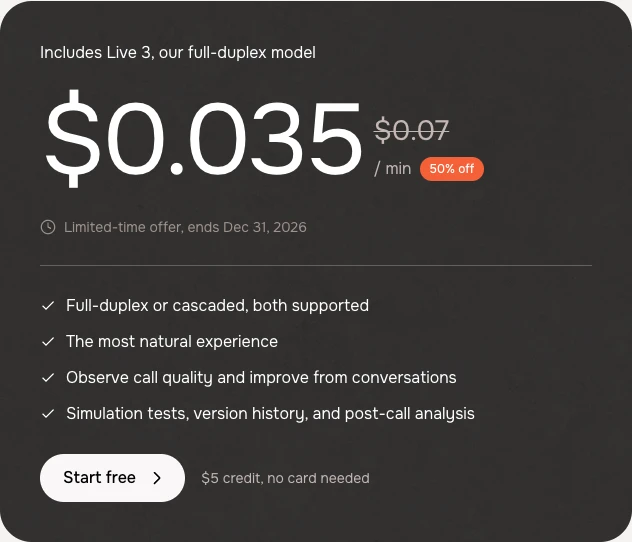
Fish Audio Live 3 is the full-duplex speech model available through Fish’s hosted Agents platform. It handles conversational pacing and overlapping speech while the platform supplies the builder, knowledge, tools and deployment. Start in the public-beta console or connect a web application with the API and SDK. The listed agent bundle costs $0.035 per minute through December 31, 2026, with phone and premium LLM charges added where used.
Content reviewed:
Open Fish Audio Live 3 ↗
Use this model
See access details in the guide below.
Use cases
- Build an English-speaking support agent that can handle interruptions.
- Test a web voice conversation against a small knowledge base and a bounded tool.
- Compare complete web and telephone session budgets before expanding call volume.
Start with the hosted Agents platform
Fish Agents is in public beta and is available to every Fish Audio account. Use the console to configure a prompt, voice, knowledge and tools, or use the REST API to manage the same agents. The browser SDK handles the live connection; the platform handles speech recognition, turn-taking and synthesis.
Live 3 is the speech engine within that workflow. The agent’s instructions, language model and tools determine the response content. Keep the speech model, the reasoning model and the deployed agent configuration separate when comparing quality or costs.
Create, test and publish a first Live 3 agent
In the Agents console, create an agent, write a short system prompt and choose a voice. Start with a narrow job such as answering opening-hours questions from one supplied document. New agents use Live 3 with the Clara voice. Use Test call to hear the draft and inspect its transcript before publishing.
For an existing agent, choose Live 3 in the speech-model selector. The following API request makes the same change to its draft. Set FISH_API_KEY only on your backend and replace AGENT_ID with the agent you created.
curl --request PATCH "https://api.fish.audio/v1/agent/agents/$AGENT_ID/config" \
  --header "Authorization: Bearer $FISH_API_KEY" \
  --header "Content-Type: application/json" \
--data '{"voice":{"engine":"live3","live3_voice":"Clara"}}'Publish a version, then connect the browser
Publish creates an immutable configuration version. Preview calls use the current draft, while real sessions use a published version. A session for an agent that has never been published returns HTTP 409. After editing a live agent, publish again when the new configuration is ready.
Your backend creates a session with POST /v1/agent/sessions and returns the short-lived session credentials to the frontend. The @fishaudio/agent-client SDK uses those credentials for the call. Keep the API key on the server; end the session when the user finishes. The official quickstart includes the full create, publish, session and client sequence.
Fish Audio Live 3 minute pricing and extras
Checked November 14, 2026, the product page lists the Agents bundle, including Live 3, at $0.035 per minute through December 31, 2026. The displayed regular price is $0.07. The regular conversation bundle includes speech recognition, speech generation, knowledge retrieval and tool calls, with the basic LLMs covered for now as a promotional offer. Other language models add their own token charges. Standard telephone calls add $0.01 per minute, with higher rates for some outbound destinations; a dedicated phone number costs $1.20 per month. Imported SIP and WhatsApp calls have different surcharge rules.
For 1,000 billed web conversation minutes, the bundle is $35 during the offer or $70 at the regular rate. For the same number of telephone minutes at the standard surcharge, with one dedicated number and no transfer minutes, add $10 in phone usage and $1.20 for the number: $46.20 during the offer or $81.20 at regular price, before any premium LLM usage or other applicable charges.
| Illustrative monthly workload | Through December 31, 2026 | At displayed regular rate |
|---|---|---|
| 1,000 web minutes, base bundle | $35.00 | $70.00 |
| 1,000 phone minutes + one dedicated number | $46.20 | $81.20 |
| Premium LLM | Add that model’s token usage | Add that model’s token usage |
Use session duration and the chosen model in the budget
The quickstart says usage is billed per second against API credit and every account starts with a one-time $5 trial balance. The balance also pays for phone sessions and token-billed models, so it does not imply a fixed number of free calls for every configuration.
Count the complete billable session and retries when estimating cost per resolved call. Do not add a standalone transcription or TTS tariff to the published bundle without a separate charge shown for that configuration. Compare premium-model usage against the call’s outcome: a longer or repeated conversation can erase a lower per-minute rate.
Check English voice support and telephone coverage
Live 3 speaks English. A session configured for another speaking language uses the agent’s text-to-speech model instead; the platform’s wider language list does not mean Live 3 itself supports every listed language. The same fallback can keep a conversation running if Live 3 cannot start or drops during a session.
The managed phone-number inventory currently covers US and Canadian local numbers. Inventory, import and call-transfer capabilities depend on the selected telephone setup. Start with a web preview, then test the intended phone route, handoff and caller experience before allocating a number or committing to a call-volume budget.
Test interruptions, tools and resolved calls
Use a short set of conversations with a clear expected result: a normal question, an interruption, a change of topic, an unavailable answer and a failed tool call. Inspect transcripts and tool outcomes as well as whether the agent sounds natural. Keep consequential actions behind the checks required by your own application.
Fish’s November 10 launch demonstrations show number confirmations, acknowledgements during speech and mid-order corrections. Its advertised 186-millisecond figure concerns a short response decision while the full answer is prepared. Use those examples to design an interruption test, rather than treating that figure as a complete answer’s end-to-end latency.
Measure audible response time from the caller’s last word to the first useful response, plus total call duration and task completion. Speech acknowledgements, a full answer and an external tool result have different timing. Compare the same agent configuration and call route when evaluating a change.
Live 3 vs Drama 3 and a local Haru model
Use Live 3 for a hosted conversation with turn-taking, agent configuration and deployment. Use Drama 3 to generate a recording from text; its hosted character billing is a different unit from Agents conversation minutes.
Haru 4B offers downloadable full-duplex research weights for local experiments. That route shifts expense to the machine, serving and application development. Compare it with Live 3 when control of local inference matters, while allowing for the difference between a research base model and a managed agent platform.
Before you use it
- Fish Agents is a hosted public-beta platform; Live 3 is its English full-duplex speech path.
- Phone service, dedicated numbers and premium LLM usage can add to the base minute bill.
How to get started
Create one narrow agent, test the draft on web calls, then publish a version and measure the complete session bill before adding telephone traffic.
Sources
Sources (7)
- Fish Agents: base bundle, add-ons and transfer billing ↗
Source checked:
- Fish Audio: Live 3 launch demonstrations and latency scope ↗
Source checked:
- Fish Audio: Live 3 product and current prices ↗
Source checked:
- Fish Agents overview and public-beta access ↗
Source checked:
- Fish Agents console/API quickstart and billing ↗
Source checked:
- Fish Agents Live 3 engine, voices and language fallback ↗
Source checked:
- Fish Agents managed phone numbers ↗
Source checked: